

Created for Connection
Throughout Scripture, community is presented as one of God’s gifts for navigating life’s joys and challenges. Whether through family, friends, a church, or a support group, healthy relationships provide encouragement, accountability, compassion, and hope. Modern research continues to show that meaningful social connections can reduce loneliness, improve emotional well-being, and support overall health. While prayer emphasizes our relationship with God, Community emphasizes our relationship with others. Together they reinforce the biblical picture that whole-person wellness grows through both vertical (God) and horizontal (people) relationships.
Investing in meaningful relationships—may be one of the greatest gifts for your well-being.
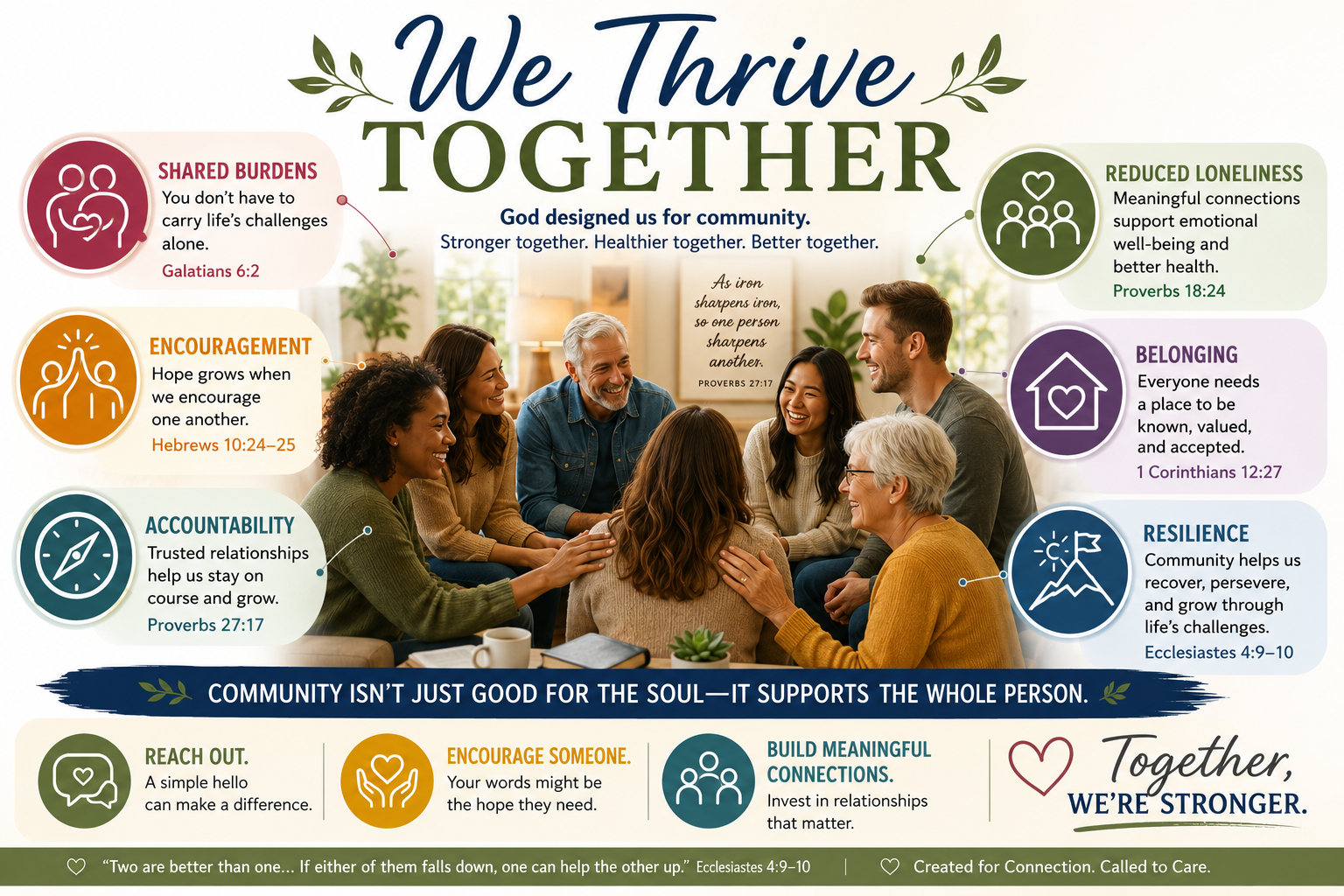
Four Biblical Principles
Bearing One Another’s Burdens
Life’s challenges become easier when they’re shared. Offering and receiving support reminds us that we don’t have to face difficult seasons alone.
Galatians 6:2 “Carry each other’s burdens, and in this way you will fulfill the law of Christ.”
Encouragement
Words of encouragement can strengthen hope, build confidence, and remind us we’re not alone. Sometimes a caring conversation is exactly what someone needs to keep moving forward.
Hebrews 10:24–25 And let us consider how to stir up one another to love and good works, 25 not neglecting to meet together, as is the habit of some, but encouraging one another…
Accountability
Healthy relationships help us grow. Trusted friends encourage us to stay focused on our goals, make wise choices, and become our best selves.
Proverbs 27:17 “As iron sharpens iron, so one person sharpens another.”
Loneliness and Health
Scripture recognizes the importance of companionship, and research agrees. Chronic loneliness has been linked to increased stress, depression, anxiety, and poorer overall health, while meaningful relationships are associated with greater resilience, better emotional well-being, and even longer life.
What Research Says
A growing body of research suggests that strong social connections are among the most important factors supporting long-term health and well-being. People with supportive relationships often experience lower stress, better emotional resilience, healthier lifestyles, and improved quality of life.
References
-
Holt-Lunstad, J., Smith, T. B., & Layton, J. B. (2010). Social Relationships and Mortality Risk: A Meta-analytic Review. PLoS Medicine, 7(7). This landmark review of 148 studies involving over 300,000 participants found that strong social relationships were associated with a 50% greater likelihood of survival. -
U.S. Surgeon General (2023). Our Epidemic of Loneliness and Isolation. This advisory concludes that social connection is a fundamental human need and that loneliness is associated with increased risks of heart disease, stroke, anxiety, depression, dementia, and premature death.